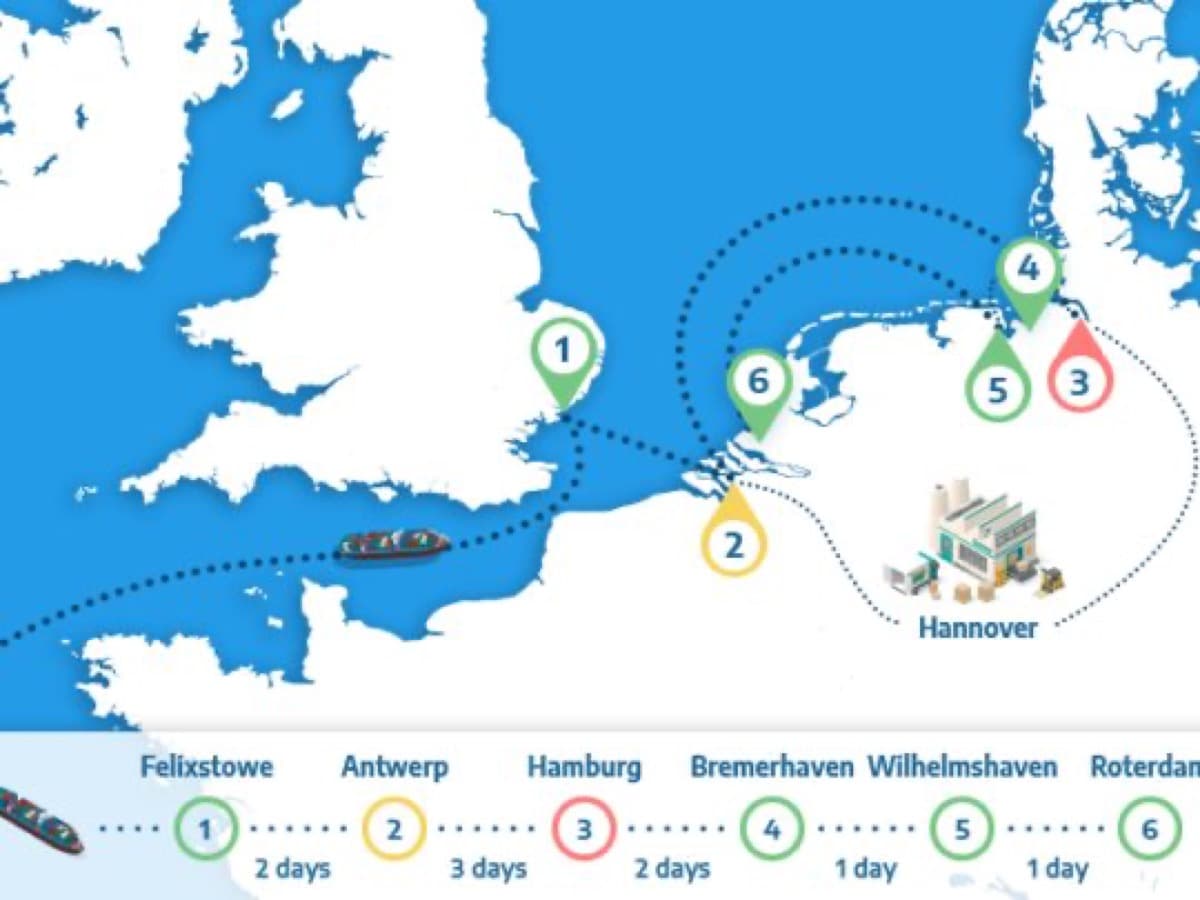
OceanOps - The Waze for Containers
OceanOps reduces delays in container transport. With a dynamic platform for route change, the brand-new company from Rotterdam enables forwarders and importers to keep their cargo under control and find the best route. The international start-up (British, Serbian, and Russian) will soon be pitching in Silicon Valley.
CEO Saif Khalaf provides some background information.
What was the reason for founding the company?
After twelve years in the container shipping industry at various levels, I was frustrated with the speed of progress in this sector. In 2018, I joined Avantida, a freight technology start-up that works for several large shipping and transport companies. Here I learned how to develop a concept and work with software developers, a fantastic experience. I resigned and joined the Antler program, a startup generator, in May 2019 to find co-founders for OceanOps.
What does OceanOps do?
One-third of the sea containers have to deal with delays due to, among other things, operational problems. OceanOps wants to do something about this for customers of container shipping companies by means of dynamic route changes. We offer alternative routes as soon as there is the risk of a delay so that cargo can arrive at its final destination on time. It's a similar concept to Waze, but instead of diverting a car when it's stuck in traffic, we do it with containers. OceanOps' platform is a software as a service and easy to use.
What distinguishes OceanOps from its competitors?
There are several start-ups that try to avoid these delays through prediction or the internet of things (IoT), but forecasting has its limitations. For example, how do you predict a port strike? The same goes for IoT. What do you do when you realize that your cargo has been delayed, even if you can trace it? You can switch to air freight, which is much more expensive than sea freight. So it's not enough to use just one of those solutions.
That's where OceanOps comes in. We can be seen as the real-time solution to divert cargo when problems arise. At the moment, we are the only startup that applies algorithms for optimal container routes from ship to destination.
It is done by combining different data sources not only from port to port but also inland. It involves planning data for more than four thousand vessels from more than one hundred carriers, together with domestic routes.
How has the industry reacted?
Since the development of our first version of the platform, we have agreed on trials with forwarders and cargo owners in less than a month. And now we will start our first paid trial in January with a Dutch freight forwarder. This is pretty fast for a B2B startup in the conservative shipping industry.
What obstacles have you encountered?
It's an exciting time in shipping and logistics because these industries are now focusing on digitalization. Due to their old IT systems, these sectors are lagging behind other industries. For example, customers have a lot of choices when it comes to the delivery of small parcels such as track and trace, delivery point, or even the choice of which day a parcel should be delivered. For containers, there are no guarantees on the delivery date.
This makes customers of shipping companies doubt whether they can change the route of their shipments. Our aim is to dispel the myth that shipping companies do not want or cannot help their customers solve delays. It is in shipping companies' interest to improve their customer service from a commercial and operational point of view. Based on our practical experience in the shipping industry, we have ensured that our platform provides our customers with all the details a shipping company needs to know to be able to reroute the shipment quickly and effectively.
What has been the highlight so far?
There have been many highlights in such a short time. For example, it was an experience to pitch venture capital early on for a couple of major investors. Also, I never thought we'd be invited to give a presentation in Silicon Valley after just five months in business.
What happens next year?
We will focus on getting our product in line with the market through trials with customers. This will help us understand all the different problems they face when routing containers and managing their logistics. We also expect to conclude some important partnership agreements in the coming year. And, of course, we will prepare to provide economies of scale.
Where will OceanOps be in five years' time?
We will be able to show our customers the most extensive capabilities of all routes, including intermodal domestic connections. We will use artificial intelligence to fully automate exception management for container transport
Tetra Inspection offers comprehensive pre-shipment inspection services to help protect your supply chain and ensure product quality.
Ensure your products meet quality standards with Tetra Inspection's during production inspection — our inspectors provide detailed reports within 24 hours.
With inspectors across Asia, including quality control in China, Tetra Inspection helps importers verify product quality at the source.
Learn more about quality inspection best practices in our AQL calculator and sampling guide.
Frequently Asked Questions
How long does it take to get ISO 9001 certified?
For most small-to-medium manufacturers, the process takes 6–12 months from starting documentation to receiving certification. This includes gap analysis (1–2 months), QMS documentation (2–4 months), implementation and internal audits (2–3 months), and the certification audit itself (1–2 weeks). Companies with existing quality processes can often accelerate this timeline.
How much does ISO 9001 certification cost?
Total costs typically range from $10,000–$50,000 depending on company size and complexity. This includes consulting fees ($5,000–$20,000), certification body audit fees ($3,000–$15,000), and internal costs for training and documentation. Annual surveillance audits cost $2,000–$5,000. The ROI usually appears within 12–18 months through reduced waste and increased customer confidence.
What are the main requirements of ISO 9001:2015?
ISO 9001:2015 is built on seven quality management principles: customer focus, leadership, engagement of people, process approach, improvement, evidence-based decision making, and relationship management. Key requirements include documented quality policy, risk-based thinking, process mapping, internal audits, management review, and continuous improvement mechanisms.
Do I need a consultant for ISO 9001 certification?
While not required, a consultant significantly increases first-attempt pass rates (from ~60% to ~95%) and reduces preparation time. They bring experience with common audit findings and can template documentation. For companies without dedicated quality staff, consulting is strongly recommended.
How does ISO 9001 certification help with supplier qualification?
Many global buyers and retailers require ISO 9001 as a minimum supplier qualification. Certification demonstrates systematic quality management, reduces buyer audit frequency, and opens doors to contracts with major brands. Tetra Inspection's factory audit services can assess your readiness before the formal certification audit.
About the Author
Mohamed Afilal
Founder & CEO, Tetra Inspection
Mohamed Afilal is the Founder and CEO of Tetra Inspection, with over 10 years of experience in quality control and supply chain management across Asia, Europe, and Africa. He has personally overseen thousands of product inspections and factory audits, helping importers, retailers, and e-commerce brands safeguard product quality at the source.
LinkedInNeed Help With This?
Our inspectors handle this across 45+ countries with 48-hour scheduling.
Get Inspection Insights
Monthly quality tips and industry data.