A Pre-Customs Clearance Inspection (Previo en Origen / PEO) is an 8-phase verification performed at the supplier's factory or warehouse before shipment, ensuring goods, documentation, and labeling comply with Mexico's Customs Law (Article 42) and applicable NOM standards — preventing holds, fines, and rejections at customs.
Comprehensive verification of goods, documentation, and NOM labeling compliance at origin — so your cargo clears Mexican customs without holds, fines, or delays.
Get a QuoteStarting from $240/man-day · No hidden fees

The Pre-Customs Clearance Inspection — known as Previo en Origen (PEO) in Mexican trade — is the single most important step for any importer bringing goods into Mexico. Grounded in Article 42 of Mexico's Customs Law, the PEO verifies at the country of origin that your shipment meets all regulatory, documentation, labeling, and tariff classification requirements before goods leave the supplier. A properly executed PEO is the difference between customs clearance in 24-48 hours and a hold that can cost you weeks of delays, fines of up to 300% of the duty amount, or total seizure of your merchandise.
Our inspector performs an 8-phase verification directly at the factory or warehouse: service order and pre-documentation review, external and internal container inspection, 100% physical count of all goods (no estimates), random box opening to verify contents against the commercial invoice, cross-referencing of all documents (commercial invoice, packing list, certificate of origin, customs declaration), complete Spanish-language labeling and NOM compliance review, HS code pre-classification, and supervised container loading with seal number documentation.
Labeling is the number one cause of PEO report rejections and customs holds in Mexico. We verify that every product carries a Spanish-language label with: product name, country of origin, importer name and RFC (tax ID), net content in metric units, lot number, expiration date (where applicable), manufacturer details, and all elements required by the applicable NOM standard — whether NOM-004 for textiles, NOM-020 for footwear, NOM-050 for general commercial products, NOM-051 for food and beverages (including front-of-pack warning seals), NOM-141 for cosmetics, or NOM-024 for electronics.
Incorrect tariff classification is another critical risk. Under 2026 Mexican customs law changes, a misassigned HS code can result in fines of 250-300% of the duty amount. Our inspector verifies that the assigned HS code matches the actual product characteristics — material composition, end use, manufacturing process, and physical form — and documents photographic evidence to support the classification against any future customs review.
We recommend starting the PEO process at least 21 days before the scheduled shipping date. This provides sufficient time to correct any documentation discrepancies, relabel non-compliant products, or resolve classification issues before they impact your supply chain.
We review the service order, importer details, product category, and applicable NOM standards. All reference documents are analyzed: commercial invoice, packing list, certificate of origin, quality and health certificates. Potential discrepancies are identified before arriving at the factory.
We photograph and record the container number, seal number, and exterior condition, verifying they match shipping documents. The empty container interior is inspected before loading: cleanliness, absence of residues, moisture damage, pests, or contamination from previous cargo.
We perform a complete count of every box, bundle, and pallet — no estimates. Quantities are broken down by SKU and product line, then compared against the packing list. Any discrepancy is immediately documented with photographic evidence.
Randomly selected boxes from different areas of the shipment are opened. We verify that actual contents match the commercial invoice description word for word: name, model, color, size, material, and country of manufacture. Product condition and packaging integrity are assessed.
Commercial invoice, packing list, certificate of origin, and customs declaration are cross-checked field by field. We verify mandatory fields: importer RFC (tax ID), full address, HS code per product, Incoterms, unit prices and totals. All documents must be originals or certified copies.
Every product is checked for Spanish-language labels with all mandatory information. We confirm compliance with the specific applicable NOM (NOM-004, NOM-020, NOM-050, NOM-051, NOM-141, NOM-024, and others). Each label is photographed in sufficient detail to be fully legible for the validation team.
We verify that the assigned HS code matches the actual product: material composition, end use, manufacturing process, and physical form. Preferential tariff claims (USMCA/T-MEC) are reviewed against the certificate of origin. Evidence is documented to support the classification at customs.
The entire container loading is supervised without interruption. A final recount is performed, the loaded container is photographed, and the new seal number is recorded. The complete report with all photographic evidence is delivered same-day so your customs broker can begin clearance immediately.
Customs clearance in 24-48 hours when your goods arrive in Mexico — no holds or secondary inspections
100% physical count of all merchandise — no estimates that create discrepancies with the customs declaration
Complete NOM labeling verification in Spanish to prevent the #1 cause of rejection at Mexican customs
Importer RFC validation on invoices and labels — an error that invalidates the entire customs declaration
HS code pre-classification to avoid fines of 250-300% for incorrect tariff assignment
Word-by-word invoice vs. actual goods verification to prevent secondary customs inspections
Continuous container loading supervision with photographic seal documentation for full traceability
Same-day detailed report delivery — ready for your customs broker to begin clearance without delays
Starting from $240/man-day · 48-hour scheduling

A practical ROI framework for quality control inspections. Learn the formula, benchmark costs of defects, chargebacks, and returns, and see real-world examples showing when inspections pay for themselves — and when they don't.
Read full article: How to Calculate the ROI of Quality Control Inspections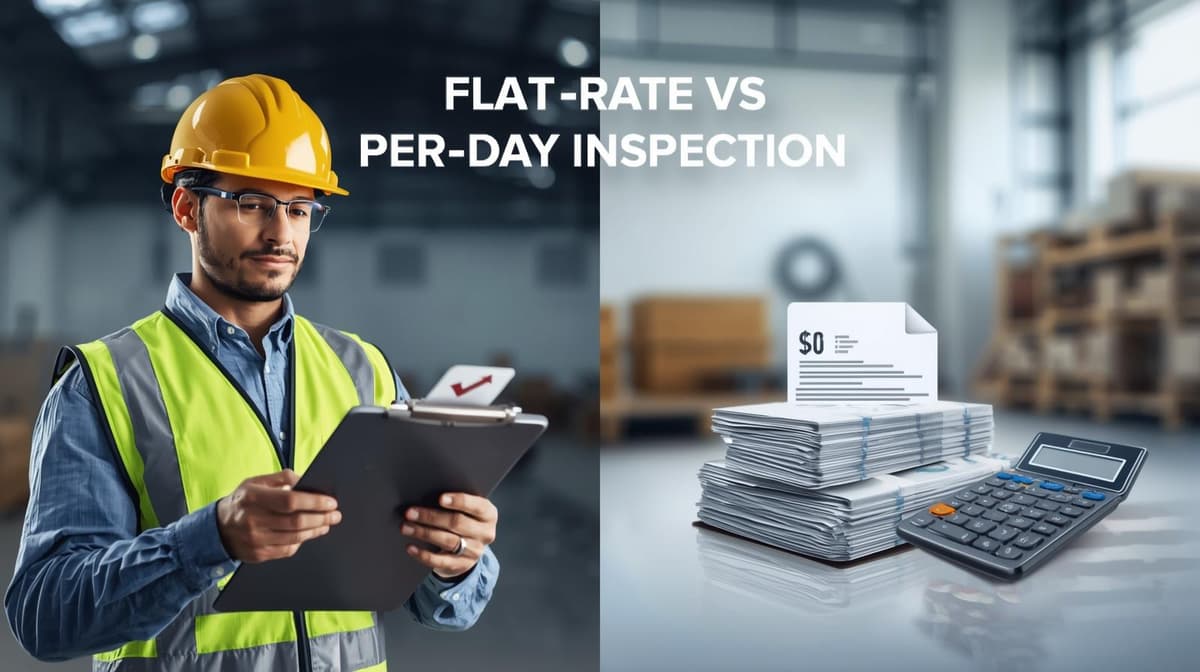
An honest breakdown of the two main pricing models in the quality control industry. Learn when flat-rate pricing makes sense, when per-day pricing is better, and how each model affects your budget, planning, and long-term QC costs.
Read full article: Flat-Rate vs Per-Day Inspection Pricing — Which Model Works for Your Brand?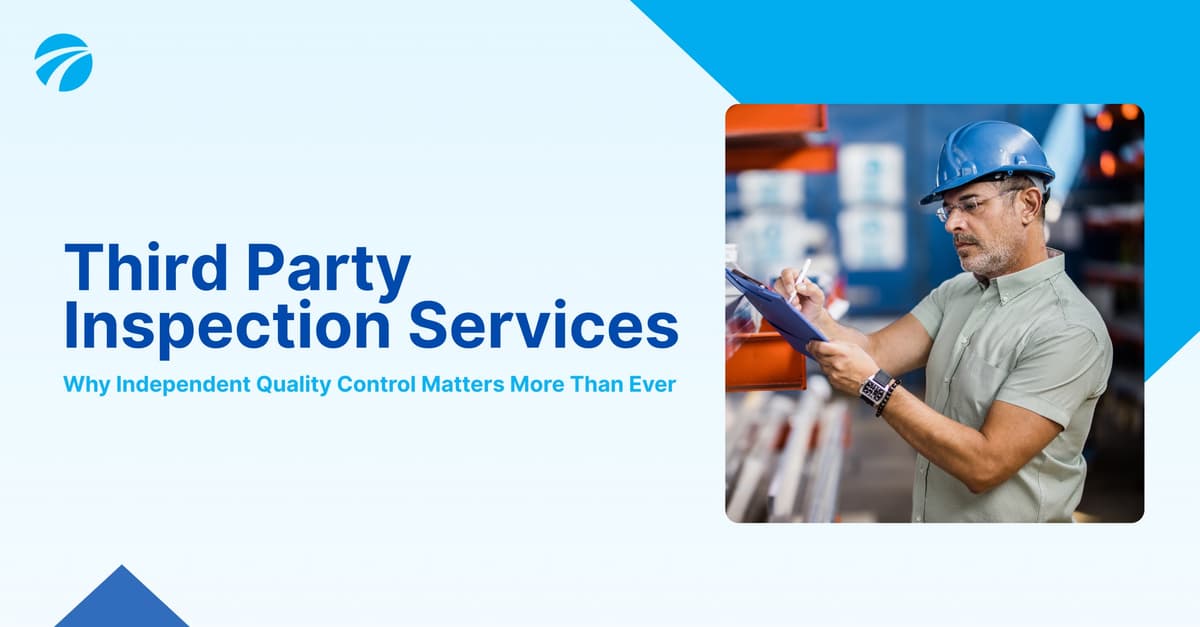
Every purchase order carries risk. You’re relying on a factory often thousands of miles away to deliver what was promised, built to the right specifications, and compliant with your market’s regulations. In practice, that chain breaks more often than buyers admit.Without independent verification, th
Read full article: Third Party Inspection Services: Why Independent Quality Control Matters More Than EverGet a quote in minutes. Our inspectors are ready worldwide.
Average scheduling: 48 hours from booking