Fact Sheet on California's Proposition 65
Proposition 65 is California's Safe Drinking Water and Toxic Enforcement Act of 1986. It requires any business selling products in California to warn consumers before exposing them to chemicals on the state's list of substances known to cause cancer, birth defects, or reproductive harm. When a product can't demonstrate exposure below the "safe harbor" level, it must carry a "clear and reasonable" Prop 65 warning label.
Proposition 65 at a glance
- What it is: California's 1986 chemical right-to-know law (Prop 65), enforced by OEHHA.
- Who must comply: Any company with 10+ employees selling into California — not only California-based businesses.
- Listed chemicals: Over 1,000 substances (e.g. lead, cadmium, phthalates, BPA, formaldehyde), updated at least once a year.
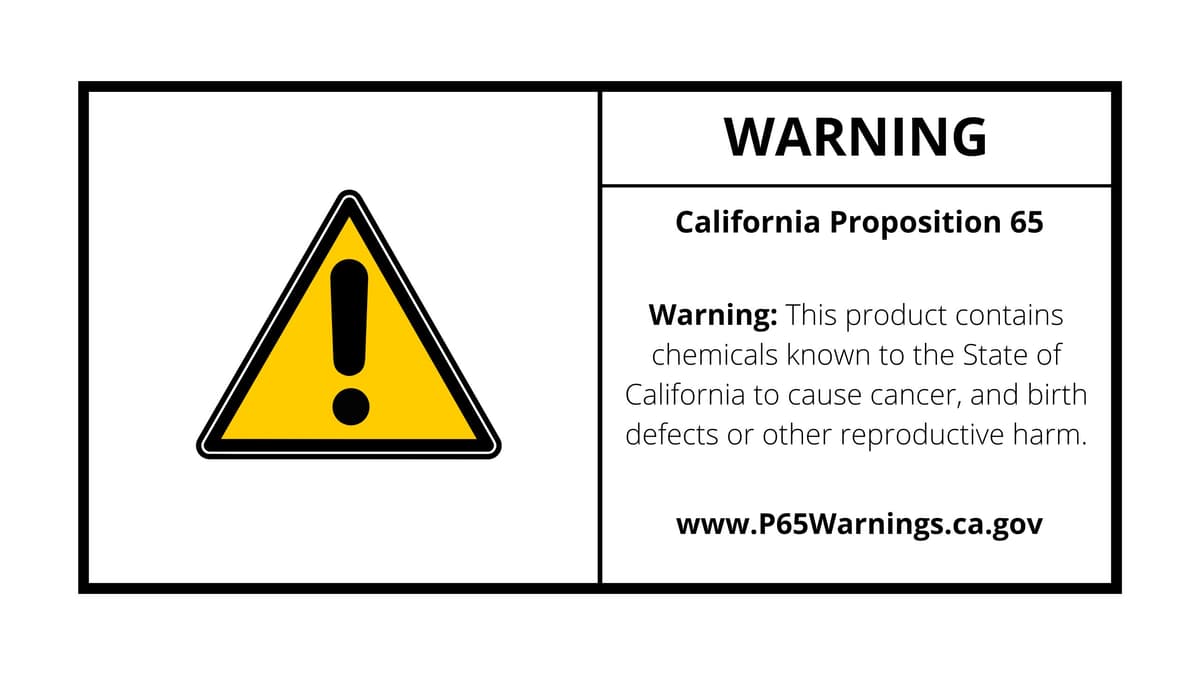
- The warning: A "clear and reasonable" label naming at least one listed chemical, the triangular yellow symbol, and the P65Warnings.ca.gov URL.
- Penalty for non-compliance: Up to $2,500 per violation, per day, plus private "bounty hunter" lawsuits.
Introduction to California Proposition 65 (Prop 65)
If you are operating in the state of California or have consumers who use your products in the state of California. You must be aware and comply with the “the Safe Drinking Water and Toxic Enforcement Act of 1986” also commonly known as Proposition 65 or Prop 65.1. What is Proposition 65?
According to the Prop 65 regulation: “Any person doing business in California who knowingly and intentionally exposes California consumers to one of over 1,000 listed chemicals. It is known to cause cancer or reproductive toxicity and must give a "clear and reasonable" warning to those consumers.” Proposition 65 is the set of laws that require businesses to keep Californians aware of the compositions of their products. If they contain certain carcinogenic chemicals, cause childbirth anomalies, or other harm to the reproductive system of the consumers. Prop 65 was passed as a law in the Californian state by a majority of 63%-37%. actually, it is aimed at keeping the water sources clean from any contamination from the cancer-causing chemicals or other chemicals. These can have toxic effects on the reproductive system of the consumers. As a result of the regulation, now businesses are required to clearly mark their products that contain a certain amount of the specified chemicals with “WARNING” labels. The entire process of Proposition 65 and its enforcement is monitored by the California Office of Environmental Health Hazard Assessment (OEHHA).2. What chemicals are on the Proposition 65 list?
For Prop 65 compliance businesses are required to put a clear WARNING label on the products. It contains known chemicals that cause cancer or other reproductive anomalies in the consumers. According to the Proposition 65 regulation, the list of chemicals that are categorized as the “known chemicals for causing birth defects and cancer” is published on the OEHHA website. It is required to be updated at least once a year (Health and Safety Code section 25249.8). The affected chemicals range from a variety of products including natural and synthetic chemicals. These are widely used in several daily use products. For instance, specific pesticides, food colors, drugs, dyes, and certain solvents are listed on Proposition 65 list of affected chemicals. A few of the products that may contain the affected chemicals can be of any of the following categories of products (the list is non-exhaustive):- Paints and other solvents
- Shoes and other footwear
- Toys and plastic products
- Cosmetics and Beauty products
- Papers, banners, and other stationery products
3. What does a Prop 65 warning mean
A Prop 65 warning label on a product indicates that the business manufacturing the product is aware of the harmful chemicals contained in the product or will be released into the environment after a chemical process. In case the business understands that the level of Prop 65 chemicals in the product is low enough to cause any harm to the consumers then such a label can be avoided (to do this a business will have to prove by the Prop testing and manufacturing inspection methods that the current level of the chemical in the product will not cause any harm to the consumers as listed in Proposition 65 regulations.) Also, it is important to note that the warning labels must be “clear and reasonable” and can be posted on the affected product/area of production in multiple ways. The instructions for the warning as available on the p65 warning website are as follows:- The name of at least one listed chemical that prompted the warning
- The Internet address for OEHHA's new Proposition 65 warnings website, P65Warnings.ca.gov, includes additional information on the health effects of listed chemicals and ways to reduce or eliminate exposure to them
- A triangular yellow warning symbol on most warnings
4. Does California Proposition 65 Apply to Your Product?
The California proposition 65 requirements apply to all businesses that are either situated and operating in California State OR are supplying products for consumers in the state of California. There are only 3 exceptions to the rule:- If a business can show that the exposure level due to their product falls at or below the “safe harbor” level. OEHHA has devised the safe harbor levels for the listed chemicals. You will have to prove to the office of environmental health hazard assessment by Prop 65 testing rules that the affected chemical in your product is below the “safe harbor” level.
- Businesses having 10 or more employees are subject to the regulations. (in case you are supplying to a larger group of distributors then even with less than 10 employees your business will have to comply with the Prop 65 compliance)
- Businesses that do not sell products to Californian consumers are also exempted from Proposition 65 compliance (in case you are supplying products to a distributor that operates in the Californian region then you must also comply with the Prop 65 regulations).
5. What Are the Consequences of Non-Compliance?
In case a product that you are supplying to Californian consumers fails the Prop 65 testing criteria AND the product does not contain a “clear and reasonable” warning label then your product will be held in violation of the regulations and the associated penalties will apply. Once a product is found in violation of the Proposition 65 compliance rules the business will be issued a 60-day notice by the Attorney General's Office. During this period the Attorney General's office can initiate an action against the manufacturer. If the AG office does not take an action a private party can file a lawsuit after the 60-day notice period. The penalty for non-violation can rate as high as $ 2,500 per violation per day. An out-of-court settlement is then solicited that can price as high as $ 60,000 for the medium-sized organizations and $1000, 000 for larger ones. It has also been discovered that a lot of bounty hunters are in search of businesses that are non-compliant with the Prop 65 regulations. Also, it can earn a fortune from them.6. The Impact of Consumer Product Recalls
Violations of the Prop 65 will not only cost you various penalties, but it will also damage the reputation of your product in more ways than you can think of. According to the Consumer Product Safety Improvement Act (CPSIA) of the US, all manufacturers are required to comply with the regulations for products. It can be hazardous for general consumers and especially children from the ages of 0-12. Once your product has been found in violation of the Proposition 65 regulations you will have to “call back” your products. As a result, consumer confidence in your product will plummet and it might take a lifetime for you to regain the level of market share after the violation. Also, recalling the products from the market may cost a fortune due to all the transportation costs, investigation costs, customer reimbursements. Also many more costs that might even send you into bankruptcy. Once the product has been removed from the market, it will take you substantial time to reach the same market share and penetration level. So people will not be confident to buy a product that has been found in violation of the regulation. Competitors will fully capitalize on this and will try their best to push you out of business during your downtime.7. How Can Tetra Inspection helps you avoid Prop 65 Violations?
Due to all the hassle associated with the Proposition 65 requirements and the potential harm a violation. It can cause for your product you must solicit the services of an expert quality inspection organization like Tetra Inspection. Tetra Inspection will not only help you keep clear from harm's way by pointing out the potential violation of the regulation by your products. It will also suggest ways of improving the product and increasing its quality. In this regard, we have designed special Initial Product Inspections and During Production Inspections (DUPRO) that enable you to identify the compliance of your end-products with regulations. As such, you will have substantial time to take corrective actions and avoid suffering from the product call-backs. Furthermore, the Proposition 65 chemical list and other associated requirements are updated regularly. As a result, Tetra Inspection will keep you posted on the relevant updates in the regulation. Also how you should take the necessary changes to avoid any violations. It is to ensure the smooth running of your business with the highest quality of deliverables.2026 Update: What Has Changed?
Since this article was originally published in 2019, the Proposition 65 list has grown to over 1,000 chemicals. OEHHA continues to update the list regularly, and enforcement actions have increased. The maximum penalty for violations remains $2,500 per day per violation, but average settlement amounts have risen. Businesses should review the latest OEHHA updates to ensure ongoing compliance.
Ensure your products meet quality standards with Tetra Inspection's pre-shipment inspection — our inspectors provide detailed reports within 24 hours.
Frequently Asked Questions
What is California Proposition 65 and who does it apply to?
Proposition 65 (the Safe Drinking Water and Toxic Enforcement Act of 1986) requires businesses with 10+ employees selling products in California to warn consumers about significant exposures to chemicals that cause cancer, birth defects, or reproductive harm. It applies to any company selling into California — not just California-based businesses.
What happens if my product fails Prop 65 compliance?
Non-compliance can result in civil penalties up to $2,500 per day per violation, plus attorney fees. Private enforcement lawsuits ("bounty hunter" suits) are common — over 700 settlements occur annually, with average payouts of $30,000–$50,000. Products may also be pulled from retail shelves and online marketplaces.
Which chemicals are on the Prop 65 list?
The list includes over 900 chemicals, updated annually by California's OEHHA. Common ones affecting consumer products include lead, cadmium, phthalates (DEHP, DBP, BBP), BPA, formaldehyde, and certain flame retardants. The full list is available on the OEHHA website.
How can third-party testing help with Prop 65 compliance?
Third-party testing laboratories can screen your products for listed chemicals using methods like XRF screening, ICP-MS, and GC-MS analysis. Tetra Inspection coordinates Prop 65 testing as part of our pre-shipment inspection process, catching non-compliant materials before they enter the US supply chain.
Is a Prop 65 warning label enough to ensure compliance?
Warning labels are a last resort, not a compliance strategy. They can hurt sales (consumers avoid "cancer warning" products), trigger marketplace restrictions, and don't protect against reformulation requirements. The better approach is testing and material substitution to eliminate listed chemicals from your products entirely.
About the Author
Mohamed Afilal
Founder & CEO, Tetra Inspection
Mohamed Afilal is the Founder and CEO of Tetra Inspection, with over 10 years of experience in quality control and supply chain management across Asia, Europe, and Africa. He has personally overseen thousands of product inspections and factory audits, helping importers, retailers, and e-commerce brands safeguard product quality at the source.
LinkedInNeed Help With This?
Our inspectors handle this across 45+ countries with 48-hour scheduling.
Get Inspection Insights
Monthly quality tips and industry data.